Why Version Control Exists: The Pendrive Problem
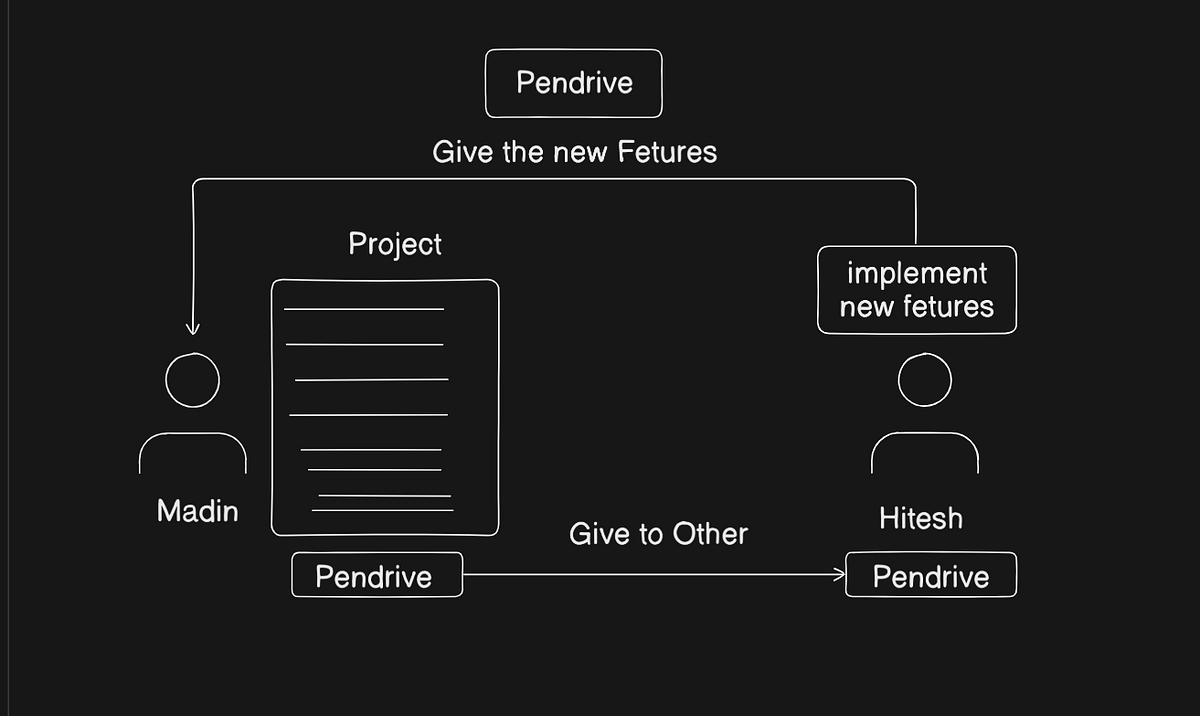
Before tools like Git existed, software development was chaotic. To understand why we need Git, we first need to look at how people managed files without it. We call this "The Pendrive Era."
1. The Pendrive Analogy
Imagine you are working on a university group project with two friends, Alice and Bob. You are writing the code, Alice is designing the website, and Bob is fixing bugs.
Without a Version Control System (VCS), the workflow looks like this:
You finish your code and save it to a folder named
Project_Final.You copy that folder to a pendrive (or email a zip file) and give it to Alice.
Alice adds her designs. She renames the folder
Project_Final_Alice_Editsand passes the pendrive to Bob.Bob finds a bug, fixes it, and renames the folder
Project_Final_Alice_Edits_Bob_Fixed.
2. The "Final_v2" Folder Chaos
This manual sharing leads to a directory that looks like a nightmare. You have likely seen a folder structure like this on your own computer:
Project_Main.zipProject_Main_Final.zipProject_Main_Final_v2.zipProject_Main_Final_REAL_FINAL.zipProject_Main_Final_Use_This_One.zip
The Problem: You have no idea which file contains the working code. If the code in "Use_This_One" breaks, you don't know which previous folder has the working version.
3. The Core Problems Faced Before Git
This "Pendrive Workflow" creates three major disasters in professional software development:
A. The Overwrite Disaster
Alice and Bob are both working on the same file (e.g., index.html) at the same time on their own computers.
Alice saves her version to the pendrive.
Bob saves his version to the pendrive 10 minutes later.
Result: Bob's file overwrites Alice's file. Alice's work is deleted forever.
B. The "Who Broke It?" Mystery
The project stops working on Friday night.
You ask, "Who changed the login code?"
Alice says, "I didn't touch it."
Bob says, "I only changed the colors."
Result: Without a history log, there is no way to prove who made the change or when the error was introduced. You have to check every single line of code manually.
C. No "Ctrl+Z" for the Whole Project
If you try a new feature and it completely crashes your software, you cannot easily "undo" the last three days of work. You have to manually try to remember what you deleted and type it back in.
4. Why Version Control became Mandatory
Version Control Systems (like Git) were invented to automate this process. They replace the "Pendrive" with a "Central Repository."
Instead of Pendrives: You "Push" and "Pull" code from a cloud server.
Instead of
Final_v2: Git keeps one folder but remembers every previous version in a hidden database.Instead of Overwriting: Git warns you, "Bob already changed this line. Please review his changes before you save yours."
5. Diagram Ideas (For Visualization)
If you are creating slides or notes, here is how you can visualize these concepts:
Diagram A: The Pendrive Workflow (The Problem)
Visual: Draw 3 computers (User A, User B, User C).
Action: Draw arrows passing a USB stick or Email icon in a circle between them.
Label: "Linear & Slow." Show a "File Conflict" explosion icon when User A and C try to save at the same time.
Diagram B: The Version Control Workflow (The Solution)
Visual: Draw the same 3 computers, but arrange them in a circle around a central Cloud Database (labeled "Git/GitHub").
Action: Draw double-sided arrows connecting each computer directly to the Cloud.
Label: "Centralized & Safe." No one waits for the pendrive; everyone updates the cloud independently.
Diagram C: The Timeline of Doom
Visual: A timeline showing files:
v1.0(Working)v1.1(Alice's edits)v1.2(Bob's edits - OVERWRITES Alice)Result: The timeline shows Alice's work vanishing into a trash can icon
.
